26 Sunscreen Brands, One Ad Angle Nobody Touches
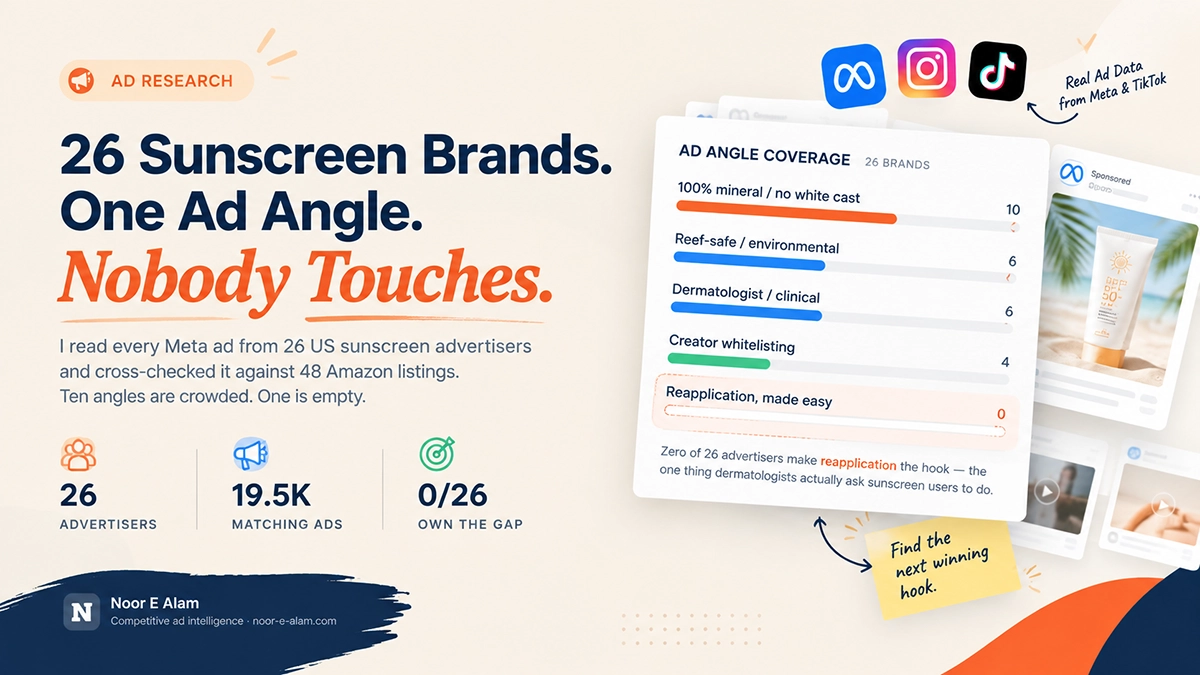
Search “sunscreen” in the Meta Ad Library and the same three claims repeat: no white cast, 100% mineral, doubles as your makeup. So I asked the same question I asked about acne: if every sunscreen ad sounds the same, what is nobody saying?
I ran five keyword searches in the Ad Library (United States, active ads only) on 26 September 2026 — sunscreen, mineral sunscreen, reef safe sunscreen, tinted sunscreen, and sunscreen stick — a combined ~19,500 matching ads as Meta itself reported them. From those, I read every ad from the 26 distinct, on-topic advertisers I could find: sunscreen-focused brands only, not retailers reselling someone else’s SPF and not travel ads that mention sunscreen in passing. I cross-checked that against 48 Amazon listings. Here is what they say, what they copy from each other, and the one angle that is almost completely empty.
-
- 10 of 26 brands lead on “100% mineral, no white cast,” and a separate 10 of 26 sell sunscreen as a tinted makeup replacement — those two claims now overlap on more than a third of the category.
-
- Only 2 of 26 target a named demographic, and only 2 of 26 use a discount, bundle, or urgency offer — both far rarer than in acne, where price offers ran on more than half the sample.
-
- One identical five-star testimonial runs under four different Page names, all routing to the same site.
-
- The under-used angle is reapplication honesty: zero of 26 advertisers make “here’s how to actually get the SPF number on the bottle” their hook.
In this article
Amazon US: what sunscreen actually sells for
Search: “sunscreen” on Amazon.com, Featured/Best Match sort — “1–48 of over 20,000 results.” I recorded 48 listings from the first results page; 27 carried a single visible unit price and are used for the distribution below (one non-sunscreen face moisturizer that surfaced as a cross-sell was excluded).
| Price band | Listings (of 27 priced) |
|---|---|
| Under $15 | 10 |
| $15–$25 | 7 |
| $25–$35 | 3 |
| $35–$50 | 3 |
| $50+ | 4 |
Sunscreen skews cheaper than either category I’ve covered before: 10 of 27 priced listings sit under $15 (Neutrogena, Banana Boat, Coppertone), while the $50+ tier is entirely dermatology-adjacent or K-beauty-import pricing (EltaMD, Colorescience). The full observed range was $8.89 to $95.85, median around $18.
By Amazon’s own “bought in past month” badge (a floor estimate, never an exact count), EltaMD UV Clear Face Sunscreen leads at 50K+/month, CeraVe Tinted Sunscreen SPF 30 follows at 30K+/month, and a seven-way tie sits at 20K+/month — Neutrogena Ultra Sheer, Blue Lizard Sensitive Mineral, two CeraVe mineral formulas, La Roche-Posay Anthelios, medicube, and Black Girl Sunscreen Original SPF 30 ($9.99, “Small Business” badge, 9.9K ratings at 4.7 stars — the highest star rating in that tier). Black Girl Sunscreen did not surface in any of my five Meta Ad Library keyword sweeps — a real gap between where it’s winning today and where it’s investing in Meta acquisition.
My benchmark listing is EltaMD UV Clear Face Sunscreen: $45–$86 depending on size, 4.5 stars across 70.8K ratings, “Allure Winner” and “Overall Pick” badges across three separate listing slots, and — per Section 3 below — the single most creator-whitelisted brand in the whole Meta sample. It’s the rare case where the Amazon best-seller and the Meta ad-spend leader are visibly the same brand.
Who runs the most sunscreen ads on Meta?
After removing retailers reselling other brands’ sunscreen, travel and lifestyle ads that only mention sunscreen in passing, and off-topic keyword collisions, I’m left with 26 distinct sunscreen-focused advertisers — more than either of my two earlier category reports (19 for hair-growth serum, 22 for acne). Every row below is verbatim from what I read, with a live Library-ID link you can click to verify yourself.
| Advertiser | What they sell | Primary angle | Started running |
|---|---|---|---|
| EltaMD Skin Care | Tinted mineral face sunscreen | Dermatologist authority + creator whitelisting (3+) | 2 Sep 2026 |
| Alastin Skincare | HydraTint Pro Mineral SPF 36 | Anti-aging bundle, tinted mineral | 3 Aug 2026 |
| Supergoop | SPF primers | Tinted / makeup-hybrid | 19 Aug 2026 |
| Sol Brush | Brush-on SPF 50 mineral powder | Reapplication-friendly format | 29 Apr 2026 |
| burnd | Zinc oxide lotion, “buy 3 get 1” | No white cast + skin-cancer framing | 10 Jul 2026 |
| jane iredale | Mineral makeup + sunscreen | Tinted / makeup-hybrid | 3 Feb 2026 |
| MDSolarSciences | Tinted mineral SPF 30 | Dermatologist authority | 28 Apr 2026 |
| Face Reality | Two SPF 50 mineral formulas | Acne-adjacent crossover | 19 Mar 2026 |
| Freaks of Nature | Spray & stick mineral SPF | Reef-safe + creator whitelisting (2) | 7 Jul 2026 |
| Badger Balm | 4–6 ingredient mineral SPF 50 | Ingredient minimalism, reef-safe | 28 May 2026 |
| Colorescience | Mineral SPF makeup | Tinted / makeup-hybrid | 28 Aug 2026 |
| NIDA Skincare (NIDA.CO) | K-beauty SPF 50 primer-sunscreen | Reef-safe — cloned across 4 Pages | 1 Jul 2026 |
| HeadBlade | HeadLube SPF 50+ for scalps | Niche body-part format | 17 Jun 2026 |
| Eufora International | Aloe-based mineral sunscreen | Hair-care brand extension | 22 Jul 2026 |
| Aloe Up Sun & Skin Care | Aloe-vera-based SPF | Sport/niche activity (golf) | 1 Jun 2026 |
| Les Duets (Shield of Helios) | 25% zinc tinted mineral SPF | Anti-aging + dermatologist-tested | 11 Oct 2025 |
| Nēmah | Mineral spray SPF 30 | Reef-safe, inclusive framing | 4 Aug 2026 |
| LATHER | Daily Defense Mineral SPF 45 | Clean-beauty extension | 5 Aug 2026 |
| Pluxos | Multi-benefit face SPF spray | Skin-condition crossover | 29 Jan 2026 |
| Prequel Skin (Dr. Samantha Ellis, MD) | Lip Visor SPF 30 | Niche body-part format (lips) | 5 May 2026 |
| DRMTLGY | Tinted Moisturizer SPF 46 | Dermatologist authority, tinted | 17 Aug 2026 |
| Vibriance | Sheer Zinc Sunscreen 3-in-1 | Demographic targeting (women 50+) | 30 Sep 2025 |
| Beauty of Joseon | Dayscreen Tinted SPF 30 Mineral | K-beauty, creator whitelisting (2) | 4 Sep 2026 |
| Sun Powder | Ingestible antioxidant supplement | Ingestible / oral format | 13 Jul 2026 |
| IT Cosmetics | CC+ Cream Foundation SPF 50+ | Tinted / makeup-hybrid | 9 Sep 2026 |
| Johnson’s Baby Sun Care | Mineral lotion & stick for babies | Demographic targeting (infants) | 11 Aug 2026 |
Also active in the same searches but not deep-profiled (adjacent format, not primarily sold as sunscreen): Perbelle Cosmetics (tone-adjusting CC cream, SPF 43), SwimZip and Nashie (UPF 50+ sun-protective swimwear), and Naturelle Nubian / Belle Nubian (French-language ad with US retail presence). Cited narratively only, not folded into the 26-advertiser counts below.
Which sunscreen ad angles are overcrowded?
A brand counts for an angle if any of its ads uses it, so the totals below don’t add to 26. Saturated means 10 or more of the 26, emerging means 4 to 9, and white-space means 1 to 3.
The sunscreen ad gap map
How many of the 26 deep-profiled US sunscreen advertisers use each angle
Saturated · 10 or more of 26
Emerging · 4 to 9 of 26
White-space · 1 to 3 of 26
| Angle | Advertisers | Status |
|---|---|---|
| 100% mineral / no white cast | 10 / 26 | Saturated |
| Tinted / makeup-hybrid | 10 / 26 | Saturated |
| Reef-safe / environmental claim | 6 / 26 | Emerging |
| Dermatologist / clinical authority | 6 / 26 | Emerging |
| Creator whitelisting at scale (2+) | 4 / 26 | Emerging |
| Format innovation (stick, brush, niche spray) | 4 / 26 | Emerging |
| Demographic-specific targeting | 2 / 26 | White-space |
| Skin-condition crossover (acne, hyperpigmentation) | 2 / 26 | White-space |
| Price, offer, or urgency | 2 / 26 | White-space |
| Sport / adventure niche positioning | 2 / 26 | White-space |
| Ingestible / oral format | 1 / 26 | White-space |
| Correct application / reapplication honesty | 0 / 26 | True white-space |
Sunscreen ad copy is being cloned
The exact same five-star testimonial — “Finally, a sunscreen that feels like a moisturizer! It’s weightless, leaves zero white cast, and gives me the perfect dewy glow… The K-Beauty sunscreen that doubles as a primer” — runs word for word under four separate Meta Page identities: NIDA Skincare, Korean Skincare 101, Tekelow, and Vsdv (which runs it twice). All four route to the same site, NIDA.CO. The Ad Library can’t show whether that’s one operator running multiple Pages, a network of affiliates given identical copy, or licensed resellers — only that the text is identical down to the emoji and the disclaimer line.
What’s genuinely rare: price and urgency
Only 2 of 26 advertisers (burnd’s “buy 3 get 1 free,” Aloe Up’s $10-off code) lead with a discount, bundle, or urgency mechanic. That’s a real contrast with my acne report, where 12 of 22 advertisers used a price or offer hook. Sunscreen in this sample sells almost entirely on formula and feel, not deal pressure — worth knowing before assuming a promo-led launch will fit this category’s norms.
What these sunscreen ads actually look like
Numbers only go so far, so here are eight real ads from the sample, each showing a different angle. Copy is exactly as captured (long copy shortened with …). Every card links to the live ad so you can verify the creative yourself.
EltaMD Skin Care
Tinted mineral face sunscreen
“This color-correcting sunscreen has become such a staple in my routine this summer.”
“Shop UV Skin Recovery Green Tint SPF 50 on my Amazon Storefront! #EltaMDPartner” — also runs the same UV Daily Hydration+ Tinted SPF 50 through at least 3 separate creator identities, each disclosed with #EltaMDPartner.
burnd
Zinc oxide reverse-emulsion lotion
“Skin cancer is no joke and we want to help as many people as we can avoid it.”
“Wearing sunscreen is the number one way to do this, but if you don’t like the way it feels, you won’t wear it. So we built one with no white cast, no grease, no stinging…” Buy 3 Get 1 Free offer.
Freaks of Nature
Mineral spray & stick SPF
“Most sunscreens leave more than a glow behind — they leave microplastics in our oceans.”
“Freaks of Nature does SPF differently. Zero microplastics, ever. Reef-safe formula, ocean approved…” Run through creator “Woahmax”; a second creator promotes the stick format.
HeadBlade
HeadLube SPF 50+ for scalps
“The world’s only sunscreen specially formulated for your head.”
“Say goodbye to sunburns & runny sunscreens that sting your eyes… HeadLube SPF 50+ is the perfect moisturizer for your sun-attracting dome.” Oxybenzone and octinoxate free, water resistant 80 minutes.
Vibriance
Sheer Zinc Sunscreen 3-in-1
“I used to think foundation was just part of being ‘put together.’ But in my 50s, it started looking heavy…”
“She said: ‘Nothing. Just my tinted sunscreen.’ That’s how I discovered Vibriance™ Sheer Zinc Sunscreen… made for mature skin.” One of only 2 of 26 advertisers naming a specific demographic.
Sun Powder
Ingestible antioxidant supplement
“You wear SPF every day. You reapply. You do everything right. And you still come inside with red shoulders.”
“Sun Powder is the inside half of the equation… Made by a Stanford skin cancer surgeon and a Harvard dermatologist… Not a replacement for sunscreen. The part sunscreen can’t do.” The only ingestible product in the sample, and it hedges carefully rather than claiming SPF-equivalent protection.
Les Duets (Shield of Helios)
25% zinc tinted mineral SPF
“Shield of Helios isn’t just sunscreen — it’s your skin’s ultimate armor.”
“Powered by 25% proprietary non-nano zinc oxide, it blocks 98% of UVA, UVB, and UVC rays for 8+ hours… Clinically proven to reduce visible aging in 4 weeks…” Longest-running ad found in this research.
Beauty of Joseon
Dayscreen Tinted SPF 30 Mineral
“TDS mom life? We had to! Quick, easy, effortless, and still put together.”
“Beauty that makes sense IRL” — promoting the Dayscreen Lightweight Tinted SPF 30 Mineral Sunscreen with ceramides, sold via Sephora, run through at least 2 creator identities plus its own brand page.
TikTok organic: a disclosed limitation
I searched the same keyword variants organically on TikTok, including USA-qualified phrasing like “sunscreen review american.” TikTok’s web search has no reliable country filter and ranks results by the viewer’s own inferred location, which for this research session resolved to Bangladesh — the same regional bias I documented in my earlier hair-growth-serum report. Even the explicitly USA-qualified query returned an overwhelmingly Bangladeshi and South Asian feed.
Rather than present that as US organic behavior, I’m excluding it from this report’s findings. TikTok organic reach for the US sunscreen market remains unverified by this research. The one exception: a search for “sunscreen review american” surfaced one genuinely US-facing account, @SKIN1004 US, reviewing the same SKIN1004 Centella sunscreen that appears independently in the Amazon top-48 (2.2K ratings, 4.5 stars, 10K+ bought/month). That’s a real cross-channel confirmation for one brand, not evidence of anything broader.
The gap: reapplication, not formula
Every one of the 26 profiled advertisers sells a better formula: more mineral, less white cast, more tint, more clinical backing. Not one sells the fact — well documented by dermatologists and the FDA’s own consumer guidance — that most sunscreen underperforms its labeled SPF not because the formula is wrong, but because people apply far less than the tested amount (roughly a shot glass, or about 1 ounce, for full-body coverage) and reapply far less often than every two hours in direct sun or after swimming or sweating.
It’s a floor, not a ceiling. This is a sample of 26 advertisers, not the whole category. Sun Powder comes closest to touching this territory, but frames it as a reason to buy an ingestible supplement in addition to sunscreen, not as a reason to trust a topical brand’s own reapplication guidance. No advertiser in the sample makes “here’s how to actually get the SPF number on the bottle” the hook for its own topical product. Test the angle rather than assume it’s uncontested market-wide.
If your sunscreen wins on being genuinely pleasant to reapply — a stick, a powder, a spray, a tinted formula that sits under makeup — this is the angle the feed has the least of: not “our formula is better” but “here’s why formula alone doesn’t save you, and here’s how to actually get full protection from what you already own.”
Four sunscreen ad hooks to test
Position the product as the one that’s honest about application, not just formula. Use only claims and figures that are true for your product and match its label and FDA-monograph testing.
-
- Story: “I reapplied every 2 hours on paper. In real life it was once at 10am and ‘I’m sure it’s fine.’ Here’s what changed when I actually set a timer.”
-
- Contrarian: “Your $45 sunscreen isn’t broken. You’re just not putting enough of it on. Here’s what a full-body dose actually looks like.”
-
- Format: “POV: reapplying sunscreen over makeup without ruining it — the real 3-step process, timed on camera.”
-
- Habit: “I stopped buying a ‘better’ sunscreen every summer and just started reapplying the one I already had. My dermatologist noticed before I told her why.”
A 15-second UGC script you can adapt
-
- 0 to 3 s: Close-up on a sunscreen bottle, phone timer visible on screen: “2:47 PM — reapplication #1 of the day.”
-
- 3 to 6 s: “Everyone talks about the SPF number. Nobody talks about how much you actually need.”
-
- 6 to 10 s: Pour a genuine shot-glass-sized amount into a palm, next to a dime-sized amount most people use, side by side.
-
- 10 to 13 s: “This is the difference between SPF 50 on the label and the SPF you’re actually wearing.”
-
- 13 to 15 s: Product on screen. “Reapply every 2 hours in direct sun.” On-screen text: individual results vary; follow label directions.
Launch checklist
-
- Test three hooks, one script, and one offer with equal small budgets. Write kill and scale thresholds down first, so you’re not judging on feel.
-
- Track hook rate (3-second views ÷ impressions), hold rate, click-through, cost per purchase, and 30-day return rate.
-
- Make the landing page match the ad: a visual “how much to apply” guide, a reapplication reminder, the full active-ingredient list (FDA-monograph actives only), and a substantiated water-resistance rating.
-
- Use real customers with written releases. Don’t reuse another Page’s testimonial script — see the cloning example above.
-
- If you sell a stick, powder, or spray, add one classic-lotion variant to the test; format loyalty in this category is still emerging (4 of 26), not settled.
Are these sunscreen claims even allowed?
This is a research summary, not legal, regulatory, or medical advice. Have a qualified professional review your claims and ads — sunscreen is regulated more heavily than most categories I’ve covered.
Sunscreen is an OTC drug, not a cosmetic. In the US, sunscreen is regulated by the FDA under the over-the-counter drug monograph for sunscreen (21 CFR 352), not as a cosmetic. Active ingredients must be on the FDA’s permitted list (zinc oxide and titanium dioxide are generally recognized as safe and effective). “Broad Spectrum” may only be claimed if the product passes the FDA’s specific test, and SPF values must be substantiated by testing. Terms like “sunblock,” “waterproof,” and “sweatproof” are restricted or prohibited; only “water resistant (40 minutes)” or “water resistant (80 minutes),” with substantiation, is permitted.
“Reef-safe” has no official certification. Six of the 26 advertisers use “reef-safe” or “reef-friendly” language. No FDA or EPA certification standard currently defines that term nationally, so it functions as an unsubstantiated marketing claim unless a brand backs it with its own testing. Hawaii’s Act 104 does specifically restrict oxybenzone and octinoxate in sunscreens sold in that state — a real, citable regulation, distinct from the generic “reef-safe” marketing phrase.
Ingestible “sunscreen” claims carry real risk. The FDA has stated publicly that no pill or supplement can replace topical sunscreen, and the FTC has previously taken enforcement action against companies marketing oral products as sunscreen substitutes. Sun Powder’s copy in this sample hedges carefully (“not a replacement for sunscreen”) — a notably safer construction than an outright SPF-equivalence claim, worth studying as an example of how to make an adjacent claim without crossing the line.
Reviews, testimonials, and disclosure. The FTC’s Consumer Reviews and Testimonials Rule (effective 21 October 2024) prohibits fake or misleading reviews and undisclosed insider reviews, and requires disclosure of material connections with creators. Several advertisers here (EltaMD, Freaks of Nature, Johnson’s Baby) did visibly tag creator partnerships — a positive compliance signal worth matching. The NIDA.CO cloned-testimonial pattern above is the opposite: an identical review script under four different names raises exactly the kind of authenticity question this rule targets.
Method and limits
-
- Source: Meta Ad Library, United States, active ads, snapshot 26 September 2026. Five keyword searches: sunscreen (~16,000 results), mineral sunscreen (~1,600), reef safe sunscreen (~130), tinted sunscreen (~890), sunscreen stick (~880) — totals exactly as Meta displayed them.
-
- It’s a sample, not the population. Meta gives no per-keyword unique-advertiser total, and results are sorted by total impressions by default, which biases toward larger spenders.
-
- Selection favored clearly on-topic, sunscreen-focused advertisers with an identifiable product. Excluded: retailers reselling other brands’ sunscreen, travel/lifestyle ads mentioning sunscreen only in passing, and off-topic keyword collisions.
-
- Start dates are the start of an active ad in the sample, not the advertiser’s first-ever ad.
-
- Amazon: search “sunscreen” on Amazon.com, Featured/Best Match sort, first pages. 48 listings recorded; 27 carried a single visible unit price and are used for the price distribution.
-
- Not covered: TikTok organic reach for the US market (see above for why), ad spend, impressions, or conversion performance. This report says what competitors say, not what converts — everything here is a hypothesis to test with small budgets.
FAQ
What sunscreen ad angles are most common on Meta in the US?
“100% mineral / no white cast” and “tinted / makeup-hybrid” are tied as the most common, each used by 10 of the 26 deep-profiled advertisers in this September 2026 sample.What is the least-used sunscreen ad angle?
Making correct application or reapplication the hook of the ad — 0 of 26 advertisers did this, despite it being a well-documented reason sunscreen underperforms its labeled SPF in real-world use.Is “reef-safe” sunscreen a regulated term in the US?
No. There’s no FDA or EPA certification standard for “reef-safe” nationally. Hawaii’s Act 104 specifically restricts oxybenzone and octinoxate in that state, which is a distinct, citable rule rather than a general “reef-safe” marketing claim.How did you collect this sunscreen ad data?
Five keyword searches in the Meta Ad Library (United States, active ads), reading every on-topic result and recording verbatim copy, creative type, angle, and a live Library-ID permalink for 26 distinct advertisers, cross-referenced against a 48-listing Amazon.com marketplace scan.Keep reading
Want a report like this built for your own category, brand, or competitor set — free, as a first look at how I work? Get in touch and tell me what you’re trying to figure out.
Leave a Comment