Hair Growth Serum Ads: What 19 US Advertisers Say on Meta & TikTok (and the Gap Nobody’s Selling)
Roughly 1 in 4 to 1 in 3 people on a GLP-1 weight-loss drug like Ozempic or Wegovy experience some hair shedding, according to a dermatologist cited by the Cleveland Clinic. It’s a large, recent, and growing audience.
I checked how many hair-growth-serum advertisers are actually talking to them. Zero of 19 deep-profiled Meta advertisers, and zero of 14 TikTok posts reviewed.
This is the second report in this series: I scanned 49 Amazon listings, deep-profiled 19 Meta advertisers with verbatim copy and live links, and checked TikTok’s organic search for the US hair-growth-serum market. Here’s what’s selling, what everyone’s saying, and the one angle nobody’s touched.
Key takeaways
- 0 of 19 deep-profiled Meta advertisers, and 0 of 14 TikTok posts reviewed, address GLP-1-related hair shedding — despite it affecting an estimated 25-33% of GLP-1 users.
- Testimonials and discount/urgency pricing are the two saturated angles, each used by 4 of 19 advertisers.
- The Amazon category clusters hard in the $15-$35 “crowded middle” (19 of 42 priced listings); only 3 clear $50.
- A persona-cloning pattern (one advertiser running identical copy under 3 fake identities) was found just outside this category — expect it to spread into hair-growth advertising as competition grows.
In this article
- What’s actually selling on Amazon
- What 19 advertisers say on Meta
- What these hair-growth ads actually look like
- TikTok organic: what I found
- Shared templates: the persona-cloning pattern
- The gap: the GLP-1 hair shed
- Hooks, headlines and a UGC script to test
- Launch checklist
- Safety and trust considerations
- Method and limits
- FAQ
What’s actually selling on Amazon
I searched “hair growth serum” on Amazon.com (Featured/Best Match, first pages) and recorded price, rating, review count and Amazon’s own “bought in past month” badge for 49 listings. 42 of those carried a single visible unit price.
Amazon “hair growth serum” price distribution
n = 42 listings with a single visible unit price
The full observed price range is $8.67 to $136, with a median around $24. Sub-$15 is the single biggest band (12 listings), driven by drugstore and rosemary-oil-style entrants.
| Top seller (by Amazon’s own badge) | Price | Bought/month |
|---|---|---|
| Bare Anatomy Rosemary Water Spray | $11.99 | 50K+ |
| Mielle Organics Rosemary Mint Hair Oil | — | 40K+ |
| Force Factor Growth Accelerator (chews) | — | 30K+ |
| Bask & Lather Scalp Stimulator Oil | $14.99 | 20K+ |
| 4-way tie (Botanic Hearth, VT Cosmetics, Dr. Groot, Moroccanoil) | — | 10K+ |
These are Amazon’s own floor estimates (e.g. “10K+”), not exact sales counts — bar length in the source data reflects that floor, not a precise figure.
The benchmark listing is Nutrafol Women’s Hair Serum ($49 for 1 fl oz, $69 for 1.7 fl oz), the clearest “market leader” positioning: highest price tier among non-device products, a full cross-sell regimen, and copy built entirely on clinical/physician language. Its 4.1★ average (3.3K ratings) is actually lower than several budget competitors above 4.4★ — premium price and premium positioning aren’t buying the highest satisfaction score here, which is worth knowing before you copy that playbook.
What 19 advertisers say on Meta
United States, active ads only. I searched “hair growth serum” (~9,000 matches), “scalp serum” (~10,000 matches) and “biotin hair growth.” 30+ distinct on-topic businesses were confirmed active; the 19 below are fully profiled with verbatim copy, creative type and a live permalink you can click to verify.
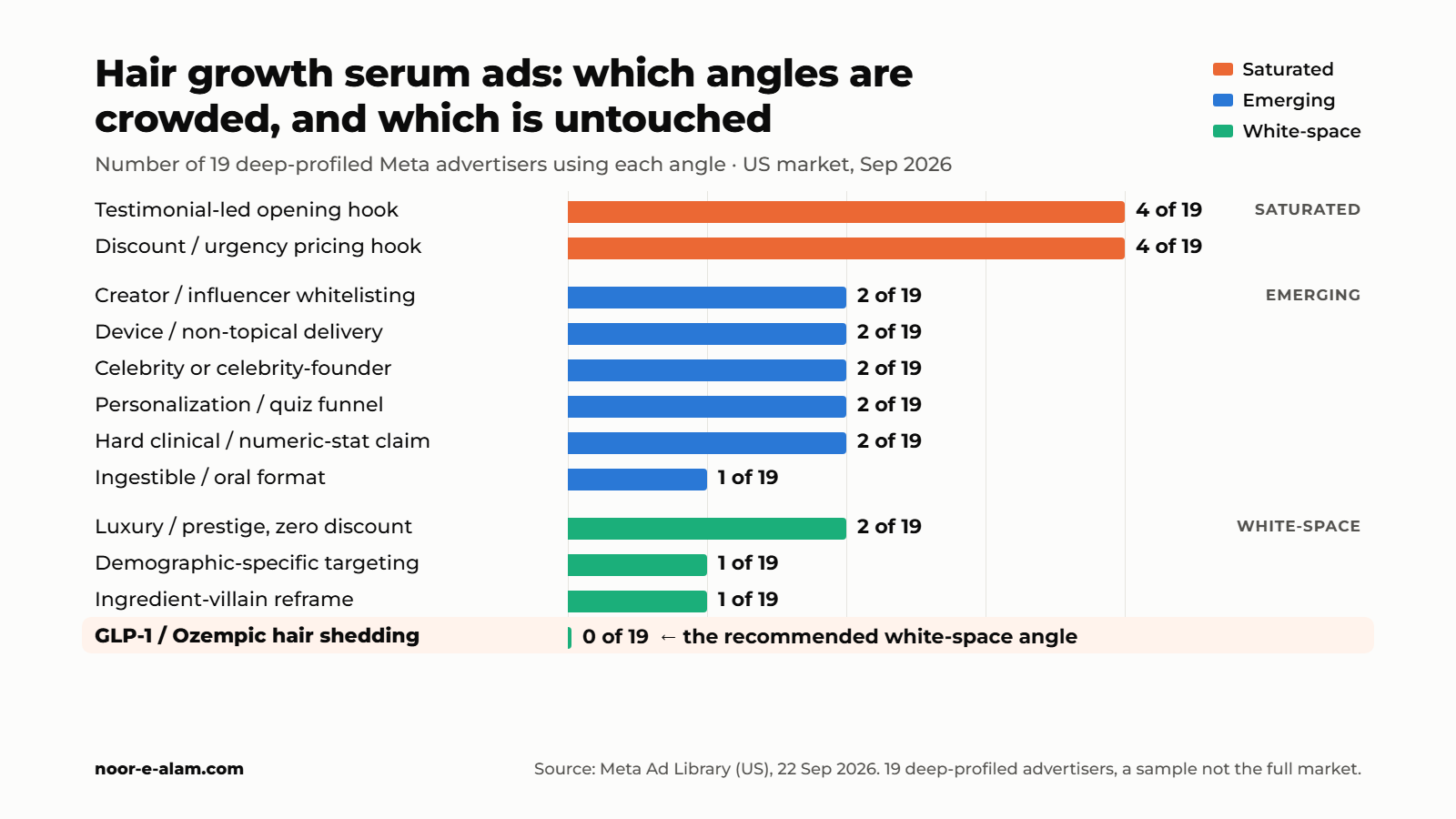
The hair growth serum ad gap map
How many of 19 deep-profiled Meta advertisers use each angle (US, Sep 2026)
Saturated · 4 of 19
Emerging · 1-2 of 19
White-space · 0-2 of 19
| Angle | Advertisers | Status |
|---|---|---|
| Testimonial-led opening hook | 4 of 19 | Saturated |
| Discount / urgency pricing hook | 4 of 19 | Saturated |
| Creator / influencer whitelisting | 2 of 19 | Emerging |
| Device / non-topical delivery mechanism | 2 of 19 | Emerging |
| Celebrity or celebrity-founder endorsement | 2 of 19 | Emerging |
| Personalization / quiz funnel | 2 of 19 | Emerging |
| Hard clinical / numeric-stat claim | 2 of 19 | Emerging |
| Ingestible / oral format | 1 of 19 | Emerging |
| Luxury / prestige, zero discount | 2 of 19 | White-space |
| Demographic-specific targeting | 1 of 19 | White-space |
| Ingredient-villain reframe | 1 of 19 | White-space |
| GLP-1 / Ozempic hair shedding | 0 of 19 | White-space |
Counts are against N = 19, the fully profiled advertisers. A further ~11 businesses were confirmed active in the same searches (including Viviscal, Keeps and Kitsch) but not deep-profiled, and are never folded into these counts.
What these hair-growth ads actually look like
Six real ads from the sample, each showing a different angle. Copy is exactly as captured. Every card links to the live ad.
Based Supplies
Ingredient-villain reframe
“Stripping your scalp with harsh sulfates and chemicals DESTROYS your hair follicles.”
Stripping your scalp with harsh sulfates and chemicals DESTROYS your hair follicles, leading to permanent thinning and loss. Restore your hair’s natural growth cycle with our Onion Hydrosol Shampoo — a powerful, ancient remedy that big beauty brands don’t want you to know about.
The only advertiser in the sample owning this narrative, despite heavy sustained spend on it.
Nutrafol
Clinical proof + subscription
“Clinically proven to support visibly thicker, fuller hair.”
Clinically proven to support visibly thicker, fuller hair. Save up to 20% when you subscribe.
The Amazon benchmark listing in this category — yet its 4.1★ average trails several budget competitors above 4.4★.
Kérastase (Chronologiste)
Luxury, zero discount
“Boost your scalp vitality with New Chronologiste Longevity Potion.”
Boost your scalp vitality with New Chronologiste Longevity Potion for fuller, thicker, healthier hair.
No promo or urgency language anywhere in the copy — one of only two advertisers with pure-prestige framing.
Virtue Labs
Celebrity endorsement (Jennifer Garner)
“”Has given me healthier hair at 52 than 35.””
“@virtuelabs has got me covered from sun up to sundown… has given me healthier hair at 52 than 35… Flourish Density Booster (makes your scalp want to grow hair!)”
K18 Hair (FutureIQ)
Hard clinical / numeric-stat claim
“FutureIQ™ delivers +19,000 more hairs.”
Experiencing shedding, early graying, and scalp aging? FutureIQ™ delivers +19,000 more hairs, +70% show fewer grays, improved scalp barrier.
The only ad in the sample combining a shedding claim with a graying claim.
SpoiledChild
Celebrity-founded + quiz + risk-reversal
“My hairline is looking fuller already.”
“My hairline is looking fuller already! Great product for reducing signs of thinning!” – Julissa G. Take the SpoiledBrain™ quiz… Results in as little as 90 days.
Kourtney Kardashian-founded brand, tagged “Try Before You Buy.”
TikTok organic: what I found
I searched the same keyword variants (plus “USA”-qualified versions) organically on TikTok.
TikTok’s search has no country filter — it’s ranked by the viewer’s own inferred location, which for this research session resolved to Bangladesh, not the US.
Despite querying in English with USA-qualified terms, most of the 14 posts reviewed were Bangladeshi resellers and creators, even when covering genuine US/international brands (Mielle, Bare Anatomy, Kérastase, WishCare). TikTok’s search UI never displays a total-result count the way Meta Ad Library does, so no volume statistic is given here. Treat this section as a directional cross-reference, not a clean US-audience sample.
What it still supports reliably: cross-channel confirmation that Mielle Organics, Bare Anatomy, Kérastase and WishCare (all found independently on Amazon and/or Meta) have real organic TikTok reach, including active reseller activity. Of the 14 posts, exactly 1 carried TikTok’s native “Paid partnership” tag — versus the creator-whitelisting pattern on Meta, which runs through creator identities without any such disclosure, since it’s a Meta-side ad format, not TikTok’s.
A notable non-finding: a direct search for “ozempic hair loss serum” on TikTok returned zero on-topic results. That matches the Meta finding below — this angle is essentially unaddressed on both platforms.
Shared templates: the persona-cloning pattern
Checking whether advertisers reuse near-identical copy (a sign of a shared agency or template) surfaced one striking pattern just outside this category, and a milder version inside it.
Outside the category, but instructive: three different Meta Page identities — “The PCOS Doctor,” “Dr. Elizabeth Reed,” and “The PMOS Doctor” — run the exact same ~2,000-word first-person testimonial script across 6 separate ad instances, all selling the same facial-hair-removal product. That’s textbook multi-persona ad cloaking: one advertiser running identical copy under several front names, likely to survive ad-account bans or A/B-test “authority framing” against “relatable-name framing.” It’s outside this report’s hair-growth category, so it’s excluded from the gap map, but expect the same tactic to spread here as competition intensifies.
Inside the category: Rennora Beauty advertises the identical serum under two audience-specific Page identities (“Rennora Beauty” and “Black Hair Growth Remedy”). And at least 4 advertisers (Bask & Lather, Mielle Organics, Kitsch, OGX Beauty) run paid ads through creator “whitelisting” — laundering the brand’s own paid spend through multiple “authentic creator” front identities rather than its own voice.
The gap: the GLP-1 hair shed
0 of 19 deep-profiled Meta advertisers, and 0 of 14 TikTok posts reviewed, name GLP-1 medication as the cause of hair shedding.
This is defensible, not a generic idea:
- It’s backed by real, current medical reporting. Per the Cleveland Clinic (citing a dermatologist’s estimate), roughly 25-33% of people on GLP-1 weight-loss drugs experience some hair shedding, caused by the body treating rapid weight loss as physiological stress (telogen effluvium), compounded by reduced nutrient intake from appetite suppression.
- The audience is large, growing, and new to hair-loss marketing. They don’t yet think of themselves as “hair loss sufferers.”
- It’s almost entirely unaddressed on both platforms checked in this research.
- Existing messaging is built for the wrong narrative. Genetics, menopause, PCOS and “years of thinning” are chronic, slow-onset stories. GLP-1 shedding is acute, recent-onset, and tied to a trigger the sufferer already knows about — none of the observed creative speaks to that.
Hooks, headlines and a UGC script to test
Position a topical hair-growth or scalp serum for people shedding hair after starting a GLP-1 medication. No new formulation is required — this is a repositioning and creative play on an existing product category.
- “Nobody warned you Ozempic would do this to your hair.”
- “Your GLP-1 shot is working on your waistline. Is it working against your hairline?”
- “25-33% of people on weight-loss shots see hair shedding. Here’s what actually helps.”
- “You didn’t sign up for thinner hair when you signed up for a thinner you.”
Four headlines:
- The Hair Side Effect Nobody Warns GLP-1 Users About
- Started Ozempic. Didn’t Expect This Shedding.
- A Scalp Serum Built for the GLP-1 Hair Shed
- Losing Weight Shouldn’t Mean Losing Hair
A 15-second UGC script:
- 0-2 s: Handheld selfie-style. “If you’re on Ozempic or Wegovy and your hair is suddenly falling out — this is for you.”
- 2-5 s: Cut to a hairbrush with visible shed hair. On-screen text: “Nobody tells you this part.”
- 5-8 s: Creator explains calmly: “It’s called telogen effluvium — your body treats fast weight loss as stress, and hair pays the price first.”
- 8-11 s: Product reveal, applied to scalp/part. On-screen text: “[Brand] Scalp Serum — built for exactly this.”
- 11-13 s: Quick “how I use it” — a few drops, massage into part, once daily.
- 13-15 s: “It’s temporary. This just helps you get through it faster.” On-screen text: “Link in bio.”
Launch checklist
- Verify claim framing with a licensed dermatologist or medical reviewer before publishing — the mechanism is real and documented, but avoid implying the serum treats or prevents the underlying medical cause.
- Avoid naming specific drug brands (Ozempic/Wegovy/Mounjaro) in Meta ad copy, to reduce trademark and policy risk. Use “GLP-1 medication” or “weight-loss injection” instead; branded terms carry lower risk in organic/TikTok content and landing-page SEO copy.
- Build one long-form, timeline-based UGC piece — a “week 1 / week 4” structure was the only format style observed with heavy, sustained ad spend in this category (Based Supplies).
- A/B test the GLP-1-specific hook against a generic “thinning hair” control before scaling budget.
- Add a visible ingredient/safety callout on the landing page — no competitor observed in this research paired a specific-cause hook with a specific-audience safety note.
- Track repurchase rate for this angle separately. GLP-1 shedding is typically time-limited (3-6 months), so expect a different repeat-purchase curve than a chronic-hair-loss buyer.
Safety and trust considerations
- Telogen effluvium linked to rapid weight loss (including GLP-1-driven weight loss) is generally temporary and self-resolves in 3-6 months. Market the serum as scalp support during that window, not as a cure or as reversing the underlying cause. (Cleveland Clinic)
- If a formulation contains minoxidil (5% OTC strength appeared repeatedly in the Amazon scan), carry the standard OTC disclosure: not for anyone under 18; not for pregnant or breastfeeding women without physician guidance; discontinue and consult a doctor for chest pain, rapid heartbeat, or unwanted facial hair growth; shedding typically resumes if daily use stops.
- For fragrance-heavy or essential-oil formulas (rosemary oil, peppermint oil, onion hydrosol — all observed repeatedly), show a patch-test recommendation and a full ingredient list pre-purchase. Several competitors lead with “sulfate-free” or “zero steroids” claims but none paired that with a visible third-party certification — a genuine cruelty-free or dermatologist-tested seal is a real, low-cost differentiator.
- Advise anyone on prescription medication (including GLP-1 drugs) or with a diagnosed scalp/skin condition to check with a physician or pharmacist before adding a new topical scalp product — an ethical baseline that also avoids implying the serum interacts with the medication itself.
- Do not claim the serum treats, cures or prevents GLP-1-induced hair loss, diagnosed alopecia, or any medical condition. Frame all claims around supporting scalp and hair condition, consistent with cosmetic — not drug — product regulation. See the FDA’s cosmetic/drug distinction and the FTC’s Consumer Reviews and Testimonials Rule.
Method and limits
- Source: Amazon.com, Meta Ad Library and TikTok, United States, 22 September 2026. Every figure traces to something directly observed; where a number couldn’t be verified precisely, it’s shown as the platform’s own displayed range (e.g. “10K+ bought in past month”) rather than converted into a fake precise figure.
- Amazon: 49 listings recorded from the first results pages for “hair growth serum” (Featured/Best Match sort, “1-48 of over 5,000 results”); 42 carried a single visible unit price and are used for the price distribution.
- Meta: searched “hair growth serum” (~9,000 matches), “scalp serum” (~10,000 matches) and “biotin hair growth.” 30+ distinct on-topic businesses confirmed active; 19 fully profiled with verbatim copy and a live permalink. Off-topic keyword collisions (an eyelash serum, a facial-hair-removal product, a pet supplement, an IV-therapy clinic) were excluded.
- TikTok: same keyword variants, organic search only. Results skewed to Bangladesh due to a regional search bias disclosed in Section 4 rather than hidden — treat this section as directional, not a clean US sample.
- Not covered: ad spend, performance or conversion data, and Amazon’s exact sales figures (only its own displayed floor estimates).
FAQ
What ad angles are most common in hair growth serum ads on Meta?
Among 19 deep-profiled US advertisers, testimonial-led opening hooks and discount/urgency pricing hooks are the most common, each used by 4 of 19.
What’s the biggest gap in hair growth serum advertising right now?
None of the 19 deep-profiled Meta advertisers, and none of 14 TikTok posts reviewed, address hair shedding caused by GLP-1 weight-loss drugs — despite an estimated 25-33% of users experiencing some shedding, per the Cleveland Clinic.
Do hair growth serum ads work better as video?
This research has no ad-spend or performance data, so it can’t say what converts. It can say video was the dominant format for testimonial, celebrity and device-led ads, while static images appeared more with clinical-proof and subscription angles.
Can I claim a serum treats hair loss caused by GLP-1 medication?
No. Claims should be framed around supporting scalp and hair condition, not curing or treating the underlying medical cause, and verified with a licensed professional before publishing.
How was this hair growth serum ad research collected?
An Amazon US marketplace scan (49 listings), a Meta Ad Library deep-profile of 19 advertisers with live links, and a TikTok organic search (14 posts, with a disclosed regional bias limitation) — all on 22 September 2026.
Keep reading
Running Meta or TikTok ads for a hair, skin or supplement brand and want this done for your own product? Book a free audit call.
Leave a Comment